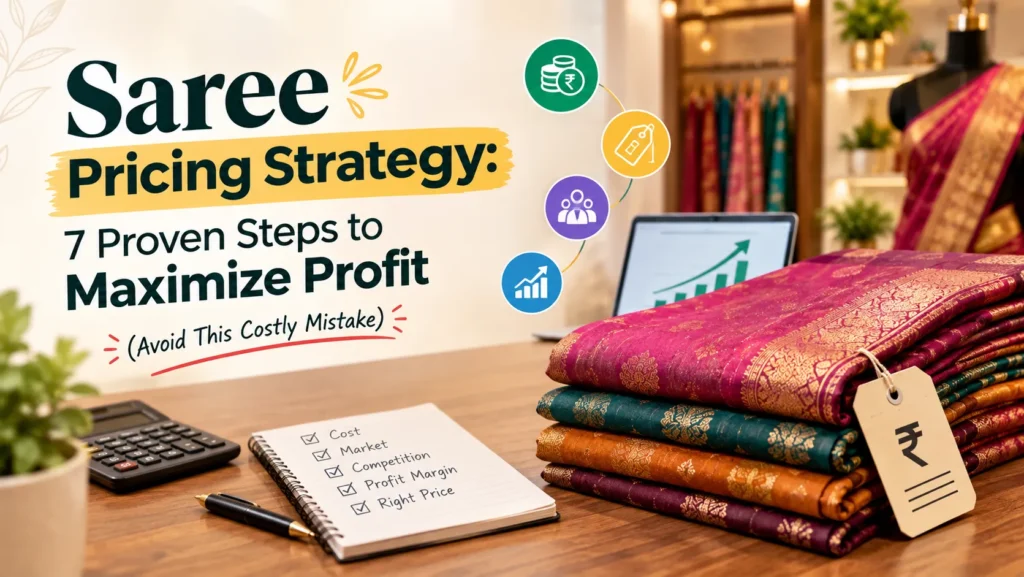
A strong saree pricing strategy is the single biggest difference between a saree retailer who struggles for cash and one who scales confidently. Most sellers don’t lose money by buying wrong — they lose money by selling wrong. Underpricing quietly drains thousands of rupees every month. Overpricing pushes customers away. This guide gives you a complete, practical saree pricing strategy you can apply to your business today.
Why Every Retailer Needs a Real Saree Pricing Strategy
Most saree sellers underprice out of fear — fear of losing the customer to a competitor. Dropping the price to close a sale feels smart in the moment. It rarely is.
Here’s why a weak saree pricing strategy hurts you long-term:
- It trains customers to always bargain — they’ll expect a discount every time
- It signals low quality, since buyers often link price to craftsmanship
- It erodes margin until you’re generating revenue with almost no profit
- It blocks reinvestment into better stock and business growth
The fix isn’t rigidity. It’s a clear, confident pricing system you understand deeply and can explain to any customer.
Step 1: Build Your Saree Pricing Strategy on the True Cost Price
Your cost price is not just what you paid for the saree. A true saree pricing strategy accounts for every hidden cost:
- Wholesale price — what you paid your supplier per piece
- Shipping cost per piece — total shipping bill divided by pieces ordered
- Packaging cost — polybags, tags, tissue can add ₹15–₹25 per piece
- Platform fees — commission if you sell via Meesho, Amazon, or apps
- Your time — home-based sellers should value their own labour too
Once you know your true cost, everything else in your saree pricing strategy becomes easier to calculate correctly.
Step 2: Segment Your Saree Pricing Strategy by Budget Tier
Different market segments support different margins. Here’s a practical reference table for your saree pricing strategy.
Mass Market Saree Pricing (₹300–₹800 cost)
Target retail: ₹600–₹1,800 | Margin: 40–60%. High volume, fast-moving stock. Never drop below 40% margin — volume only works when margin is protected.
Mid-Segment Saree Pricing (₹800–₹2,500 cost)
Target retail: ₹1,500–₹5,000 | Margin: 50–70%. This is the sweet spot for most Indian retailers — quality-conscious but price-aware buyers. A 55–60% margin is sustainable here.
Premium Saree Pricing (₹2,500–₹8,000 cost)
Target retail: ₹5,000–₹20,000+ | Margin: 60–120%. Bridal and premium buyers aren’t comparison shopping — they’re buying craftsmanship and trust. Never apologise for a premium price on a premium piece.
Step 3: Festival Season Saree Pricing Strategy
Festivals are the biggest leverage point in any saree pricing strategy — yet most retailers use them backwards. They discount when they should hold firm.
During peak festival season, customers are least price-sensitive. She’s buying for Navratri, Diwali, or a wedding. Design and availability matter more than price. This is the worst time to discount.
- Pre-festival (6–8 weeks out): Launch new stock at full price and reward early buyers with best selection
- Peak window (2 weeks to 3 days before): Hold price firmly — this is where most volume happens
- Post-festival: A 10–15% reduction helps clear leftover stock, or exchange it through Navaarth for next season’s designs
Step 4: Psychology Tricks That Strengthen Your Saree Pricing Strategy
Price is a signal, not just a number. These principles sharpen any saree pricing strategy.
Charm Pricing
Price at ₹999 instead of ₹1,000, or ₹1,499 instead of ₹1,500. The perceived value gap is larger than the actual rupee difference.
Anchor Pricing
Show a higher-priced saree first. Once ₹4,500 registers as the reference point, a ₹2,200 saree feels like excellent value.
Bundle Pricing
Raise average order value without feeling like a discount:
- “Buy any 2 sarees, get a stitched blouse piece free”
- “Saree with matching dupatta — ₹2,800 together”
- “3 daily-wear cotton sarees for ₹2,100”
Step 5: Handling Discount Requests Within Your Saree Pricing Strategy
Every retailer hears “thoda kam karo.” Here’s how to protect your saree pricing strategy without losing the sale:
Value Redirect: “I can’t reduce this one — it’s fresh Surat stock — but I’ll include a matching blouse piece.”
Alternative Offer: “I can’t go lower on this design, but let me show you something similar at a lower price point.”
Loyalty Reward: “Since you’re a regular customer, I’ll reserve this design and include free delivery.”
Never say a flat “no.” Say yes to the customer while protecting your margin.
Step 6: Track Your Margins Every Month
You can’t improve what you don’t measure. Each month, calculate:
- Total revenue collected from all sales
- Total cost of goods sold for sarees that sold
- Gross margin — revenue minus cost, divided by revenue, times 100
- Unsold stock value needing exchange or promotion
A healthy saree business runs a gross margin of 45–65%. Below 40% means your sourcing cost is too high, your selling price is too low, or both.
Pricing confidence comes from sourcing confidence. When your stock is sourced directly from Surat at true wholesale price — via Navaarth — you never need to undercut yourself to justify the value.
The Foundation Every Saree Pricing Strategy Needs
The single best way to protect your margin is to start with the right wholesale price. Sourcing directly from Surat through Navaarth’s video call service means no middlemen and no inflated catalogue markups. A lower cost base gives your saree pricing strategy room to stay competitive while still protecting the margins your business needs to grow.
👉 Book a Video Call with Navaarth — Source Smarter, Profit More
FAQs on Saree Pricing Strategy
What is the ideal margin in a saree pricing strategy?
Most healthy saree businesses maintain a gross margin between 45% and 65%, depending on the segment — mass market, mid-range, or premium.
Should I discount sarees during festival season?
No. A strong saree pricing strategy holds price firm during peak festival demand, since customers are least price-sensitive at that time. Discount only after the festival to clear leftover stock.
How do I calculate the true cost price of a saree?
Add wholesale price, shipping per piece, packaging cost, platform fees, and your own time — not just the invoice amount from your supplier.
How do I handle a customer asking for a discount?
Redirect to value instead of price — add a free blouse piece, offer free delivery, or show a similar design at a lower price point rather than cutting your margin.
Why does sourcing affect my saree pricing strategy?
A lower, direct wholesale cost — like sourcing straight from Surat manufacturers through Navaarth — gives you more room to price competitively while still protecting your margin.